



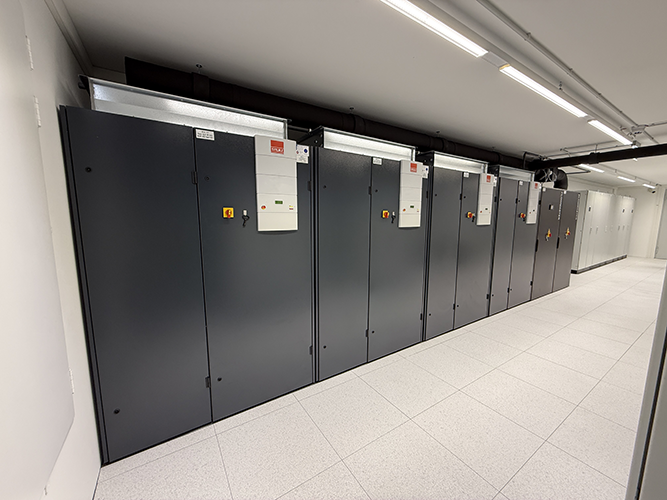
N-1 redundancy describes a security principle for technical systems. If one of the n available components fails, the remaining n-1 components assume full functionality. In a data center, this primarily affects power supply, cooling, and network connectivity. Without this reserve, a single defect directly leads to an outage of operations.
What does N-1 redundancy mean?
The term originates from the planning of power grids and describes the (n-1)-criterion there. A network section must also remain stable even if a single line or transformer fails. For this reason, the principle has been applied to critical infrastructures, including the Redundancy in the data center.
In a computing center, N-1 redundancy means that for a specific function, such as power supply, several equivalent components are available. If one of them fails, the remaining capacity is sufficient to continue operations without interruption. Operational reliability results from the design of the entire system, independent of any individual component.
N-1 and N+1: two terms that are often confused
In practice, N-1 and N+1 are often used synonymously, although they describe different perspectives on the same principle.
- N-1 describes the failure itself. One of the n components fails, the remaining n-1 take over the function. The term originates from network planning and KRITIS security.
- N+1 describes the architecture with which this failure is protected. An additional reserve component is added to the number n of required components.
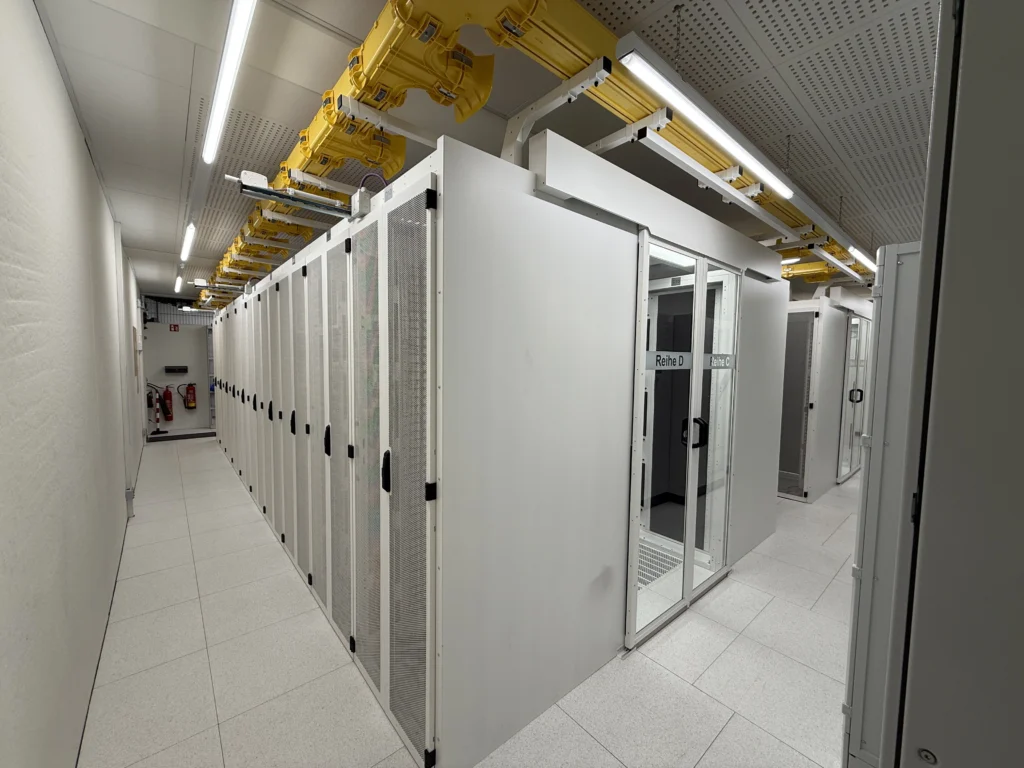
For the practice, this means that an N+1 architecture meets the N-1 criterion because it compensates for the failure of a component without interruption. When people talk about N-1 redundancy in the context of a data center, they usually mean the same thing as N+1.
Redundancy levels at a glance
Redundancy can be implemented in various stages. The higher the stage, the greater the reliability of operation, but also the construction and financial costs.
- NPrimary load without reserve. Each component is held in reserve only once; a failure immediately leads to a disruption.
- N+1In addition to the primary load, an additional component is added. If one unit fails, the reserve unit takes over without interrupting operation.
- N+2Two additional components are available, for example in case a unit fails while a second is being serviced.
- 2NEvery critical component is completely duplicated. Two independent systems run in parallel, none of which forms a single point of failure.
- 2N+1The complete doubling from 2N is supplemented by an additional reserve component, the highest expansion level in practice.
Which level is appropriate depends on the criticality of the IT processes, not only on the size of the company. Modular data center It is well suited to gradually expand from N+1 to higher levels without having to redesign the entire infrastructure. How these levels can be physically implemented is decided upon in the planning phase: spatial separation of critical systems, separate supply routes, sufficient space for emergency and fallback concepts. These questions belong in a well-thought-out plan. Architecture planning for data centers, Long before the first stone is laid.
Relationship to the animal stages
The redundancy levels N to 2N+1 are closely related to the Tier classification of the Uptime Institute. Tier I and Tier II offer little to no redundancy and are suitable for applications with lower availability requirements. Tier III usually requires N+1 redundancy for all critical components. Tier IV requires a 2N or 2N+1 architecture with completely independent power supplies. The Tier classification therefore describes how consistently a data center implements the redundancy levels across its entire infrastructure, not just in individual areas.
N-1 redundancy and KRITIS: legal framework
For operators of critical infrastructure, redundancy is not a voluntary option. The BSI Act and the IT security legislation require CRITICAL operators to demonstrate appropriate measures against disruptions. The BSI IT Basic Protection recommends a redundant design for critical infrastructure components; implementation usually takes place as part of a risk analysis in accordance with BSI standard 200-2.
For companies outside the KRITIS sector, these requirements are not binding, but often serve as a guide for their own security planning. The best way to determine which requirements apply in a specific case and what level of redundancy is appropriate is to consult a security expert. RZ Consulting clarify before the concrete planning begins.
Georedundance as a supplement
Georedundancy goes beyond the redundancy of individual components. Instead of maintaining reserve components in the same location, systems or data are mirrored in a second, geographically separated location. The BSI recommends a minimum distance of 200 kilometers for this, so that a regional event such as a widespread power outage or a natural disaster does not affect both locations simultaneously.
Not every company needs a second dedicated data center from the beginning. For the interim period, for example while a georedundant location is planned and built, or for individual projects with a temporary need, a mobile data center It can be deployed at any location at short notice as a flexible interim solution, thus bridging the gap until a permanent georedundant infrastructure is in place.
Where N-1 redundancy is used in practice
In practice, N-1 redundancy mainly concerns three technical areas that have the greatest impact on operational safety in the event of a failure.
- Power Supply If the power supply fails, an uninterrupted power supply must take over the systems within milliseconds. USV in the server room It is already designed during planning so that it compensates for the failure of a component without interrupting operation.
- Cooling: The principle also applies to air conditioning: if a cooling unit fails or is undergoing maintenance, the remaining capacity must be sufficient to continue discharging the heat load. For critical infrastructure, a Server room cooling layout it accordingly in a redundant way.
- Fire alarm and extinguishing technology: Especially in telecommunications data centers with particularly high availability requirements, security-relevant systems are also included in the redundancy planning. Fire safety in the server room It is designed here so that fire detection and extinguishing systems are also designed to be redundant and are coordinated with the redundancy concepts for power and cooling.
How Daterra plans and implements redundancy concepts
Redundancy does not arise through the subsequent addition of individual components, but through planning that considers the power supply, cooling, security technology, and building structure from the outset as a cohesive system. If an UPS system is planned without considering cooling or structural separation, interfaces will arise where the theoretical level of redundancy no longer holds in practice.
At the Resource planning Daterra establishes the redundancy level already during the concept phase, together with the sizing of power supply, UPS and grid replacement systems, and cooling. The subsequent technical implementation is handled by Data center construction, Also in case of expansions during operation.
This level of planning applies not only to companies with their own data center. Operators of Colocation-Flächen is tasked with implementing the required redundancy levels in a structural and technical manner; Daterra supports this as a planning and construction partner.
You can rely on this when working with Daterra:
One contact person for all sectors:
Experience in the field:
Building law support:
Implementation nationwide:
Have a redundancy concept planned for your data center
From the design of the appropriate redundancy level to the technical implementation: Daterra supports your project from the initial analysis to commissioning.
Frequently asked questions about N-1 redundancy
What does N-1 redundancy mean?
N-1 redundancy refers to a security principle: one of n existing components must fail, the remaining n-1 components will take over the function completely. The term is used synonymously with the N-1 criterion and the N-1 principle and originated originally from the planning of power networks.
What is the difference between N-1 and N+1?
N-1 describes the failure itself, N+1 the architecture that protects against this event. In a redundant power supply with N+1 components, an additional reserve component is added to the required number n. If a unit fails, this architecture meets the N-1 criterion because the remaining capacity is sufficient.
What does 1:1 redundancy mean?
With 1:1 redundancy, each active component receives its own, permanently assigned backup component. This distinguishes it from N+1, where multiple active components share a common backup. 1:1 redundancy offers higher fault tolerance, but it also requires more hardware.
What is redundancy in the data center?
Redundancy in the data center means that critical systems such as power supply, cooling, and network connectivity are provided multiple times. If one component fails, the others take over the function, ensuring that operations continue without interruption.
What is georedundancy?
Georedundancy means mirroring systems or data at a second, geographically separate location. The BSI recommends a minimum distance of 200 kilometers for this, so that a regional event does not affect both locations simultaneously.