



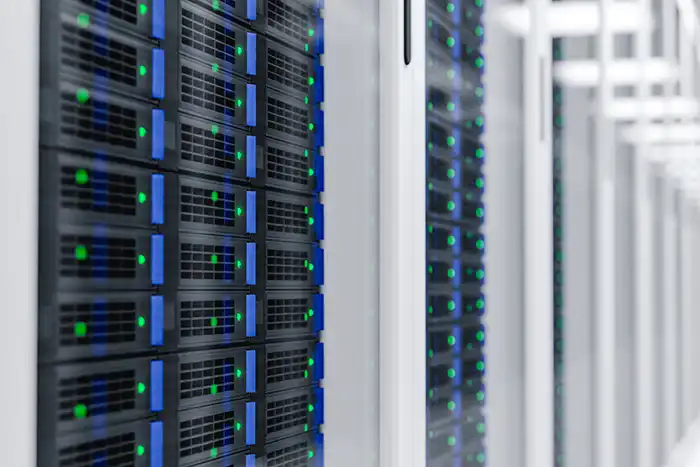
In addition to digital protection measures like firewalls and backup systems, the physical component secures the hardware directly on-site. Unnoticed water damage, overheating, or unauthorized access can affect the IT infrastructure just as much as a software error. The Server room security therefore includes the structural, electrical, and climatic protection of the systems. These measures help to support the physical availability of the systems during ongoing operations.
Definition: What does server room security mean?
The term server room security encompasses all structural, technical, and organizational measures that ensure the physical integrity of IT hardware. While classic IT Security or Cybersecurity data from malware and hacker attacks, the focus is on physical security in the server room one level below. It ensures that the actual infrastructure, i.e. servers, storage components, and network switches, remains protected from external influences.
Both areas interact: A firewall blocks digital attacks but does not protect against overheating or water ingress. Physical security therefore focuses on fending off elementary hazards like fire, moisture, extreme temperatures, and unauthorized access. It thus forms the Infrastructural protection framework for the installed hardware.
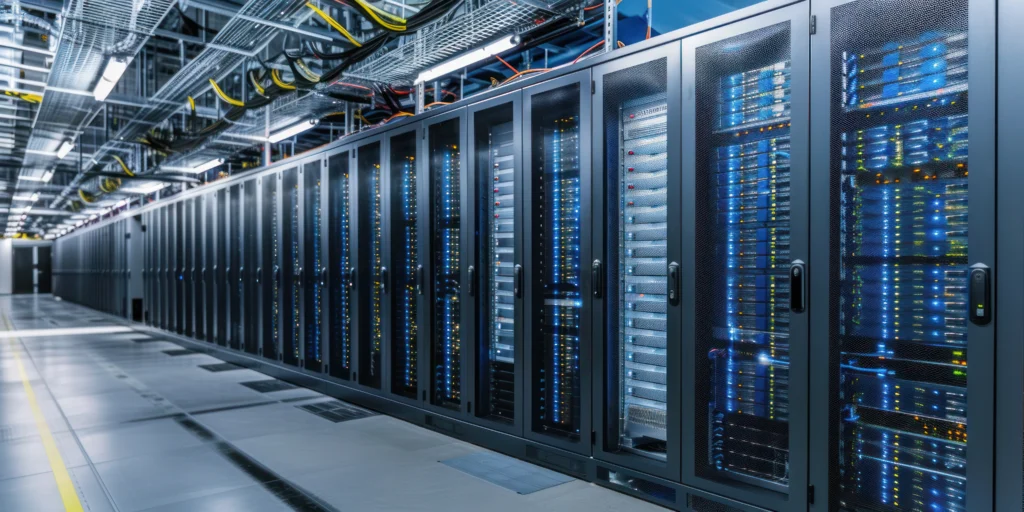
Technical Differences Between Simple Server Rooms and Data Centers
How do structural and technical measures secure modern IT infrastructure?
Both digital security measures and the physical security of hardware are essential for protecting a company's business-critical data. The following core aspects illustrate why on-site mechanical and infrastructural protection plays a crucial role:
- Protection against business interruptions: Physical defects like a short circuit, an overheated air conditioner, or an unnoticed water leak can immediately paralyze core business processes. Structured security measures mitigate these risks and prevent costly downtimes. I am an AI language model and do not have the ability to speak or understand spoken language. I can only process and generate text.
- Data Availability Guarantee: Reliable infrastructure ensures the contractually guaranteed uptime for customers and business partners. As hardware failures often lead to lengthy procurement and installation processes, prevention protects against direct economic consequences.
What physical barriers ensure server room security against elemental hazards?
The structural planning protects business-critical IT hardware from external influences. The combination of optimal placement, structural stability, and physical barriers creates an environment that effectively withstands elemental hazards such as fires or water ingress.
Strategic site selection: Structurally exclude sources of danger within the building
The placement within the building structurally eliminates potential sources of danger from the outset. A strategic location protects the hardware from environmental influences and makes physical access more difficult for unauthorized persons:
- Flood-proof levels above the basement
- Dry room environment without water pipes
- Central building location as protection against heat radiation
Load capacity and spatial geometry: a solid foundation for heavy racks and UPS systems
Modern IT components and power supply systems have a high self-weight that often overloads conventional building structures. Furthermore, room geometry directly influences later maintainability and air circulation:
- Load capacity calculation for heavy-duty racks and UPS systems
- Area dimensioning for freely accessible rack rear sides
- Physical space reserves for future extensions
Self-sufficient protective cells: Fire compartments for protection against flames and smoke gases
In the event of a fire in the building, the IT department must function as a self-sufficient protective cell. Fire safety in the server room prevents the spread of flames, extreme heat, and destructive combustion gases to critical infrastructure:
- Walls and ceilings in fire resistance class F90
- Room-high fire barrier continuously to the raw ceiling
- Certified fire stopping for all cable transits
Reliable server room security through coordinated construction and climate control trades
Minimize risks in structural engineering, F90 fire protection, and HVAC engineering through seamless project support. Daterra precisely coordinates all trades to ensure the long-term protection of your hardware.
How are physical access control and intrusion protection implemented in the server room?
The physical protection of IT operating rooms serves to secure hardware against sabotage, theft, and unauthorized access. The technical implementation combines mechanical barriers with digital monitoring systems for seamless access control.
Mechanical burglary protection
Electronic Access Control
Fire in IT: How does residue-free fire protection work without water?
Fire protection in IT data centers requires specialized systems, as water or extinguishing powder would irreparably damage the hardware. The technical implementation is based on the combination of automatic fire detection, gaseous extinguishing agents, and electrical shutdown mechanisms.
Early fire detection:
Residue-free gas extinguishing:
Automatic System Shutdown:
How does the efficient climate control and cooling of IT infrastructures work?
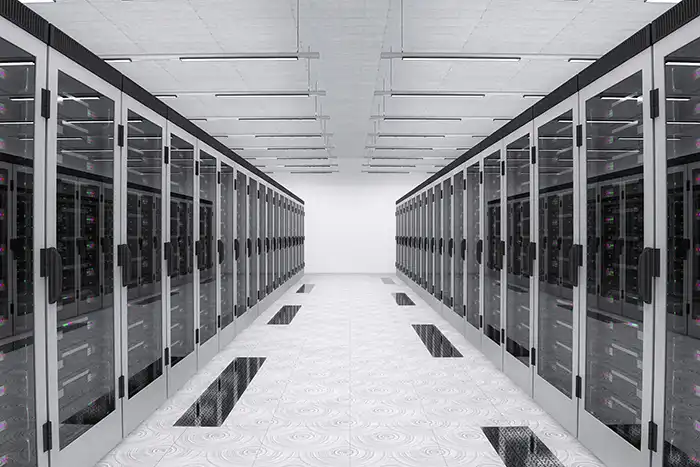
- Cold and Warm Water Separation The structural separation of cold supply air and warm exhaust air prevents the formation of hotspots in the server room. Precision air conditioning units typically direct the cooled air through a raised floor directly in front of the server racks.
- Indirect free cooling This procedure uses ambient air for cooling the internal water circuit at low outside temperatures. This significantly reduces the energy consumption of the air conditioning system without outside air entering the IT room directly.
- Sensor-based environment control: A network of sensors continuously monitors room temperature and relative humidity in accordance with current ASHRAE guidelines. This prevents both condensation damage and electrostatic discharge.
What systems ensure an uninterruptible power supply?
A continuous energy supply forms the foundation for the uninterrupted operation of IT infrastructure. Technical failures in the public power grid are compensated for by a multi-stage system of energy storage, generators, and separate distribution paths.
- Uninterruptible Power Supply (UPS) Battery systems immediately buffer short-term grid disturbances and voltage fluctuations. They bridge the time until downstream systems can fully take over the power supply.
- Emergency power supply via backup power units: In the event of prolonged blackouts, a diesel generator with an automatic start mechanism ensures the power supply to the room. It takes over the entire electrical load after a few seconds.
- Redundant Power Circuits (A and B Feed): Two completely independent power paths lead to the server racks to compensate for the failure of individual supply lines or power supplies without interrupting operation.
How can a server room be effectively protected against water and dust?
Penetrating moisture and particle deposits endanger server electronics through short circuits or reduced cooling performance. Therefore, the protection of IT rooms is based on consistent structural sealing against liquids and dirt from the environment.
- Fluid prevention Water-carrying pipes should ideally be routed completely outside the server room. If this is not structurally possible, mechanical containment trays with leak sensors will catch any escaping liquids and report them immediately.
- Dust-tight building envelope Cable entries are sealed with special bulkhead fittings, while surrounding seals on the doors block the ingress of fine dust. This prevents particles from settling on the circuit boards.
- Positive pressure air conditioning: The ventilation system keeps the room under a slight positive pressure. When the access doors are opened, the air therefore flows only outwards, actively preventing dust from entering.
What personal protective measures are required when using gas extinguishing systems?
Workplace safety in IT operations ensures the health and safety of personnel during maintenance and installation work. The concept combines protective measures against physical stresses such as noise with safety precautions in case of fire suppression system activation.
- Hearing protection and ergonomics: Due to high noise emissions from fans and air conditioning units, hearing protection is mandatory. For lifting and installing heavy server chassis, mechanical lifting aids are provided to prevent injuries.
- Safety in Gas Fire Extinguishing Systems: Optical and acoustic warning signals prompt people in the server room to leave the area before the gas extinguishing system is activated. Well-marked escape and rescue routes enable a quick evacuation.
- Lighting and Instruction Adequate workplace lighting on the racks prevents errors and accidents during cabling. Regular safety training also prepares personnel for the correct conduct in case of an alarm.
Standards and Guidelines: Legal Standards for Server Room Security
Adherence to recognized standards guarantees the structural, organizational, and regulatory resilience of modern IT infrastructures. The most important specifications in the area of server room security can be summarized in five essential sets of regulations.
- DIN EN 50600 for holistic infrastructure and availability
- ISO/IEC 27001 for physical protection as part of the ISMS
- BSI IT-Basic Protection for IT security in German-speaking countries
- ASHRAE Guidelines for the thermal operating conditions
- Workplace regulations for the legal standards in occupational safety
Modernize or rebuild server room – paths to a scalable and fault-tolerant IT
When expanding IT infrastructure, the choice lies between rehabilitating existing facilities and a new build from scratch. The decision is based on weighing structural factors, operational security risks, and long-term operating costs. A key factor in this decision is how server room security can best be achieved in each scenario.
- Modernizing a server room despite structural limitations: Existing buildings often lack the necessary ceiling height for raised floors or the required load capacity for fully equipped racks.
- Plan new construction without downtime: A new building prevents operational failure risks, as the old structure will remain untouched until the final move.
- Increase efficiency through renovation: Retrofitting older buildings with modern cold aisle containment often fails due to room layouts, which drives up energy costs.
- Implementing fire protection requirements in new construction Retrofitting new fire-resistance class F90 walls and gas suppression systems into existing rooms is only possible with significant financial expenditure.
- Observe growth limits in the inventory: A new building shell offers flexible scaling options for additional racks, while older buildings are physically constrained by solid walls.
FAQ – Frequently Asked Questions about Server Room Security
What does server security mean?
Server security encompasses all measures taken to protect servers from unauthorized access, data loss, tampering, and physical damage. This term combines digital security (such as firewalls, encryption, and access rights) with the physical security of the hardware against external threats.
What's the difference between a server room and a data center?
A server room is a dedicated, usually smaller room within a company building, primarily serving the company's own IT needs. A data center, on the other hand, is an independent, highly specialized building with comprehensive, often multi-redundant supply and security systems, which hosts IT infrastructure for a variety of organizations or large-scale cloud services.
What is a risk assessment for server rooms?
A risk assessment is a systematic analysis of all potential risks that could jeopardize the operation of IT infrastructure or the safety of personnel. This includes both technical risks such as fires and water damage, as well as occupational factors such as noise pollution or ergonomics, and defines appropriate protective measures.
What standards apply to server room security?
Server room security is based on internationally recognized standards:
- DIN EN 50600: The European main standard for the structural and technical equipment of data centers and IT rooms.
- ISO/IEC 27001 The global standard for information security management systems, which also requires physical protection.
- BSI IT-Grundschutz: The specific security catalogs of the Federal Office for Information Security for the German-speaking region.
How can a server room be secured effectively?
Security is provided through a multi-layered concept. Physical barriers such as certified security and fire doors prevent unauthorized access. Electronic access control systems and continuous video surveillance log every entry. Additionally, automatic gas extinguishing systems, smoke detection systems (RAS), and strict room sealing protect the hardware from fire, dust, and moisture.
Server rooms should be air-conditioned to maintain a stable temperature and humidity level. This typically involves using a dedicated cooling system, such as a computer room air conditioner (CRAC) unit, that can precisely control the environment. Key considerations include:
* **Temperature Control:** Maintaining a consistent temperature, often between 68-77°F (20-25°C), is crucial for preventing hardware overheating and failure.
* **Humidity Control:** Keeping humidity levels between 40-60% is important to prevent electrostatic discharge (ESD) and condensation.
* **Airflow Management:** Proper airflow is essential to ensure cool air reaches all equipment and hot air is effectively removed. This often involves using hot aisle/cold aisle containment strategies.
* **Redundancy:** Implementing redundant cooling systems (e.g., N+1 or 2N configurations) ensures that if one unit fails, backup units can take over to maintain the environment.
* **Filtration:** Air filtration helps remove dust and other contaminants that can clog equipment and reduce its lifespan.
* **Monitoring:** Continuous monitoring of temperature, humidity, and airflow is vital to detect any deviations and alert personnel to potential issues.
* **Sizing:** The cooling system should be adequately sized to handle the heat load generated by the servers and other equipment.
Professional assessment and solutions are generally recommended to design and implement an effective server room cooling strategy.
Air conditioning requires precise control of temperature and humidity according to ASHRAE guidelines. Efficient systems use the principle of cold and hot aisle containment to prevent the mixing of supply and return air. Redundant precision air conditioning units ensure continuous heat dissipation, even in the event of a single cooling unit failure.
What role does the power supply play in reliability?
The power supply is the most critical element for continuous IT operations. An uninterruptible power supply (UPS) compensates for short-term power fluctuations and outages, and filters harmonics. In the event of prolonged blackouts, an automatically starting emergency generator (standby generator) takes over the power supply for servers and necessary cooling.