



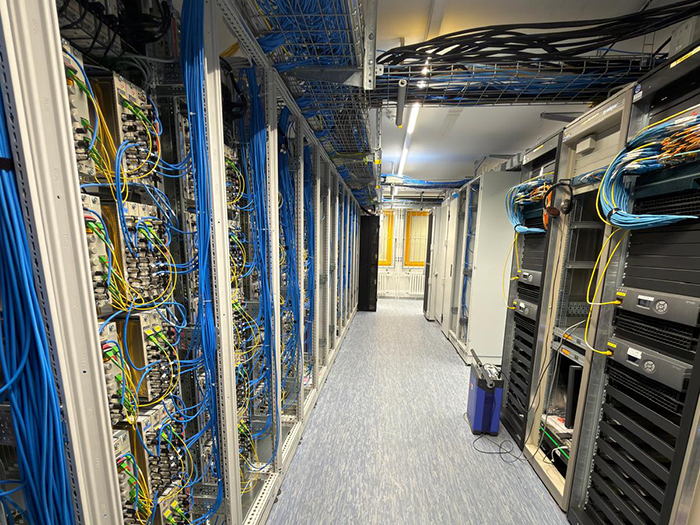
A voltage drop in the millisecond range is enough to restart servers, cause data corruption, or overload sensitive control electronics. Uninterrupted power supply (USV) intercepts such network disruptions and ensures the continuous supply of critical electrical consumers.
What is an uninterrupted power supply?
Uninterrupted power supply, internationally Uninterruptible Power Supply (UPS), It switches between the power grid and sensitive electrical consumers. If the mains voltage drops or the power quality fluctuates, the system ensures uninterrupted supply.
The core element is a integrated energy storage from lead- or lithium-ion batteries. In the event of a failure, the system delivers power within a few milliseconds or completely seamlessly. It bridges short outages until a backup generator kicks in or provides time for the controlled shutdown of critical systems.
How does an uninterrupted power supply work?
One Rectifier Converts the incoming alternating current from the public grid into direct current. This current powers the internal batteries and keeps the accumulators permanently charged. The back-mounted inverters It generates clean alternating current from the direct current with a stable frequency and voltage that powers the connected consumers. If the power grid fails, the battery provides the required energy directly to the inverter.
The system has an automatic system for disruptions or overload situations. Bypass circuit. This static switch bridges the internal electronics in the event of defects or maintenance within a few milliseconds and connects the loads directly to the mains.
What types of USV are there and how do they differ from each other?
|
Offline-USV |
Line-Interactive UPS |
Online USV |
|
|
Standard designation |
VFD (Voltage and Frequency Dependent) |
VI (Voltage Independent) |
VFI (Voltage and Frequency Independent) |
|
Switching time |
4 to 10 ms |
2 to 4 ms |
0 ms (no interruptions) |
|
Working method |
Directly feeds mains power in normal operation. Switches to battery mode in the event of a failure via a relay. |
Reduces voltage fluctuations via an auto transformer, without loading the battery. |
Converts alternating current continuously into direct current and back again into clean alternating current (double converters). |
|
Area of application |
Individual workstations, office PCs, simple network hardware |
Small server rooms, peripherals, network racks |
Data centers, medical infrastructure, critical control systems |
USV and emergency power generator: technical differences and use in crisis situations
|
Uninterrupted power supply (USV) |
Emergency power unit (NEA / diesel generator) |
|
|
Primary protective function |
Continuously filters network outages and immediately bridges voltage drops |
Provides a permanent power supply in the event of prolonged power outages |
|
Reaction and switching time |
0 to a maximum of 10 milliseconds. The supply continues seamlessly. |
10 to 60 seconds. The internal combustion engine must start and be revved up. |
|
Time for bridging |
5 to 30 minutes at full load. The duration depends on the battery capacity. |
Unlimited, as long as fuel is replenished. |
|
Energy source |
Battery systems (lead-acid or lithium-ion) |
Internal combustion engine (usually diesel) with generator |
|
Application |
Protection of sensitive IT hardware, server rooms and process controls |
Security of entire buildings, data centers and industrial infrastructure |
Where is uninterrupted power supply used?
An uninterrupted power supply protects critical infrastructures from the consequences of sudden network outages. Depending on the application area, the requirements for response time and bridging time vary.
- Data centers and server rooms: Power outages lead directly to data loss and system crashes. Online UPS systems permanently secure servers, storage arrays, and network hardware and keep operations running until generators kick in.
- Healthcare: In hospitals, operating room equipment, intensive care units, and life-support systems depend on a secure power supply. Seamless switchover times prevent hazards for patients in the event of network fluctuations.
- Industry and production: Manufacturing lines and robotic controls react sensitively to the slightest fluctuations in voltage. USV systems prevent costly production outages, tool breaks, or lengthy system restarts.
- Financial sector and trade: Banks, stock exchanges, and transaction servers continuously process sensitive data. Downtimes in the millisecond range disrupt booking processes and cause significant financial damage.
Uninterrupted power supply: selection criteria for the correct sizing
When purchasing an uninterruptible power supply, the planned requirements profile determines the technical design. Four parameters form the foundation of the selection:
- Performance and capacity: The apparent power in volts-ampere (VA) and the effective power in watts (W) must cover the rated load of all connected consumers. A sizing with a power reserve of 20 to 30 percent prevents future expansions and short-term load peaks when devices are turned on.
- Time for bridging: The capacity of the energy storage system determines how many minutes the system can supply the loads at full load. Depending on the protection goal, the range of minutes can range from a few minutes for a controlled shutdown to a time buffer until a backup generator takes over the supply.
- Battery technology: Classic lead-acid batteries (VRLA) or modern lithium-ion batteries are used for energy storage. Lithium-ion systems offer significantly longer lifespan, lower weight and greater tolerance to higher ambient temperatures compared to conventional lead-acid batteries.
- Redundancy concept: Critical systems require a redundant system architecture. The technical design and structural integration of a N1 redundancy ensures reliable operation even in the event of component failures.
Secure USV projects without the risk of interfaces
Avoid coordination efforts when installing your uninterruptible power supply. Professional planning, retrofitting during operation, and turnkey delivery ensure reliable protection against outages.
Uninterrupted power supply in the data center: Integration into the overall infrastructure
Uninterrupted power supply in data centers rarely works as a standalone device. It is only when it is combined with the Server room air conditioning, the extinguishing systems and a coordinated Redundancy concept Ensures operation. If the mains power fails, the battery system provides power to both the servers and the cooling control system. Without functioning air conditioning, the components overheat within a few minutes, triggering an emergency shutdown despite intact power supply.
Accordingly, professional engineers at the Facility Planning Failover as a component of the entire infrastructure is no longer necessary. Increasing server performance requires flexible systems that can dynamically adapt to changing workloads. A structural Fire safety in the server room It additionally protects the battery compartment from thermal hazards. The connection to the existing building technology requires this. clean interfaces to all the participating trades.
Maintenance and lifetime: measures for permanent failure safety
The reliability of an UPS system directly depends on regular maintenance. While the built-in electronic components provide a Life span of 8 to 12 years To reach their full capacity, energy storage devices deteriorate much more quickly. Classic lead-acid batteries typically last for 3 to 5 years, With higher room temperatures noticeably accelerating the aging process. Lithium-ion batteries reach their 10 to 15 years, However, they require higher initial investment. Automatic self-tests only check basic functions. A manual Capacity test under real load ensures that the batteries actually provide the required buffer time in an emergency. Annual inspections detect thermal abnormalities, aged capacitors, and loose connections before defects lead to system failure.
FAQ about uninterrupted power supply
What function does an uninterrupted power supply fulfill?
An uninterrupted power supply ensures the safety of critical consumers during power outages and filters out fluctuations and disruptions from the public power supply network. The system prevents data loss, hardware defects, and costly downtime.
Are USV and USP the same thing?
Both terms describe the same system. USV stands for the German term for uninterrupted power supply, while UPS is the English abbreviation for Uninterruptible Power Supply.
What three types of UPS systems are there?
According to the IEC 62040-3 standard, the systems are divided into offline UPS (VFD), line-interactive UPS (VI), and online UPS (VFI). They differ in their operating methods, switching times, and the quality of the output voltage provided.
How does a stationary battery storage system differ from a conventional UPS system?
Stationary battery storage systems primarily serve to intermediate store energy for self-consumption optimization or to cap peak loads. USV systems, on the other hand, secure high-sensitive loads and guarantee extremely short response times in the millisecond range in the event of network outages.
How long does an UPS last during a power outage?
The bridging time depends on the capacity of the batteries and the connected load. Standard USVs or modular battery systems that can be expanded ensure full-load operation for 5 to 30 minutes to orderly shut down IT systems or to bridge the time until an emergency generator starts up.
When is the use of an online UTP required?
Online UPS systems offer zero milliseconds switching time and complete disconnection from the mains. Their use is necessary wherever sensitive servers, Data center solutions or medical devices do not tolerate any voltage fluctuations.
How often does the replacement of the installed batteries need to be done?
The replacement intervals depend on the selected storage technology. Conventional lead-acid battery systems have a lifespan of 3 to 5 years. In contrast, modern lithium-ion cells last 10 to 15 years, which reduces the higher initial cost over the lifetime.