




One Turnkey solution refers to the realization of a turnkey overall system that a service provider implements independently, from the initial conceptualization through all phases to commissioning. Clients receive a completely operational system, which can be put into operation immediately after handover without any need for custom adjustments. The model minimizes coordination risks at the interfaces of complex trades, as the entire project responsibility is bundled in one hand.
Definition: What is a turnkey solution?
The term Turnkey comes from English and means translated turnkey. The idea behind this is simple: the client takes over a plant and metaphorically only needs to turn the key to start operations. In technical plant engineering, this describes a project model that is fundamentally different from the classic Standard components distinguishes. Instead of purchasing pre-made individual systems and integrating them themselves, companies receive a custom-made bespoke item. The service provider assumes complete responsibility for planning, installation, and final functional testing, ensuring the system is fully operational on the handover day.
Turnkey Solution – The Four Core Characteristics of Project Management
The awarding of a turnkey project completely relieves the client's internal teams. By consolidating all technical risks into one hand, even complex large-scale projects can be realized in a predictable manner. This procedure is characterized by four essential core features:
- Overall responsibility at the service provider: The contractor manages all project phases, including the initial conception, realization, and handover of the ready-to-operate system.
- Central Point of Contact: Communication runs through a single point of contact, eliminating time-consuming coordination and interface conflicts between different trades.
- Turnkey handover The complete finished system is transferred to the customer's ownership fully functional, without the need for them to perform any further work.
- Customization Each system is custom-made, precisely tailored to the structural specifications and technical requirements of the site.
Turnkey solution and the differences from the classic individual contract"}
| Criterion | Turnkey solution | Classic Sole Sourcing |
| Contracting party | A single general contractor for the entire project. | Separate contracts with the respective trades. |
| Coordination effort | It lies entirely with the service provider; the client's internal teams are relieved of the burden. | Remains with the client who takes over the management of the trades himself. |
| Interface risk | The contractor is liable for planning and coordination errors between trades. | It lies with the client, as the contractual transition points are defined by them. |
| Price stability | High planning certainty through contractually agreed fixed prices for the entire system. | Total budget, based on individual bids and trade settlements. |
| Warranty | A single point of contact is liable for defects in the overall system. | Warranty claims are to be asserted directly against the respective trade. |
This direct system comparison shows how organizational priorities shift. While turnkey implementation minimizes administrative risks and conserves client personnel resources, classic individual procurement offers maximum transparency and direct intervention options in each individual trade.
Efficient project execution without operational effort
Eliminate interface risks through seamless overall responsibility. You receive a turnkey, tested system that is ready for immediate use after acceptance and conserves your resources.
Turnkey Solution: The Typical Phases of Project Execution
The implementation of a turnkey project follows a clearly structured, chronological process. Since the service provider bears responsibility for the overall system, the individual planning and execution steps mesh seamlessly:
Requirements analysis and preliminary planning:
Detailed planning and approval process
Procurement and Manufacturing:
Assembly and structural implementation:
Commissioning and functional testing:
Acceptance and Handover
What economic benefits does a turnkey solution offer?
The decision to go with a turnkey project model shifts the administrative burden and execution risks entirely to the service provider.
- Minimized internal coordination effort through central project management
- Guaranteed Price Security due to contractually agreed fixed prices
- Reduced interface risks through the contractor's complete and continuous responsibility
- Compact project timelines seamlessly interlocking planning and construction phases
- Simplified warranty claims through a single contracting partner
These clear structures completely eliminate time-consuming coordination between separate trades, thereby conserving internal resources and maximizing the project's plannability from the outset.
A turnkey solution makes sense for companies when they need a ready-to-use system or service that can be implemented quickly and with minimal internal effort. This is often the case when: * **Speed is critical:** The company needs a solution immediately to address a business challenge or seize an opportunity. Turnkey solutions are pre-built and can be deployed much faster than custom-developed systems. * **Limited internal resources or expertise:** The company lacks the in-house technical skills, personnel, or time to develop a solution from scratch. A turnkey solution outsources the development and integration work. * **Standardized business needs:** The company's requirements align well with the capabilities offered by a pre-packaged solution. The problem being solved is common enough that a standardized approach works effectively. * **Cost predictability is important:** Turnkey solutions often come with a fixed price, making budgeting easier and reducing the risk of cost overruns associated with custom projects. * **Focus on core business:** The company wants to avoid diverting resources and attention away from its primary business activities to focus on a technical implementation. * **Minimizing risk:** Turnkey solutions often have a proven track record and are developed by specialists, which can reduce the risk of failure compared to an in-house or novel development. * **Scalability needs are met:** The turnkey solution is designed to scale with the business's growth, often with tiered pricing or modular options. In essence, a turnkey solution is beneficial when the cost, time, and risk associated with developing a custom solution outweigh the benefits of customization.
This model is ideal for companies that do not have their own specialized construction department in-house or want to relieve their internal teams. Outsourcing of overall responsibility ensures that the daily core business is not blocked by the operational control of a construction site.
A turnkey solution is particularly worthwhile for highly complex Infrastructure projects, which take place during ongoing operations. When sensitive technical systems are modernized, consolidating all trades under one roof minimizes the risk of costly operational failures and ensures project success.

Secure Data Center Construction: The Role of Turnkey Solutions in the Data Center Sector
The Building a data center or the modernization of existing IT infrastructure requires maximum precision so as not to jeopardize subsequent reliability. Because highly complex systems such as air conditioning, power supply, and fire protection must seamlessly intertwine, the turnkey model efficiently mitigates operational risks:
- Unrestricted Joint and Several Liability The general contractor assumes full responsibility for the flawless interaction of all technical components. This prevents costly interface conflicts between the individual trades from planning to handover.
- Minimizing risk in ongoing operations: Modernizations of critical facilities are carried out without interrupting the existing IT infrastructure. The service provider coordinates the construction phases in such a way that there is no risk to data availability.
- Turnkey functional guarantee: The Data center solution or the modernized section will only be handed over for operation after intensive technical tests. Clients will receive a tested overall system including complete documentation.
FAQ: Frequently Asked Questions about Turnkey Projects
Turnkey
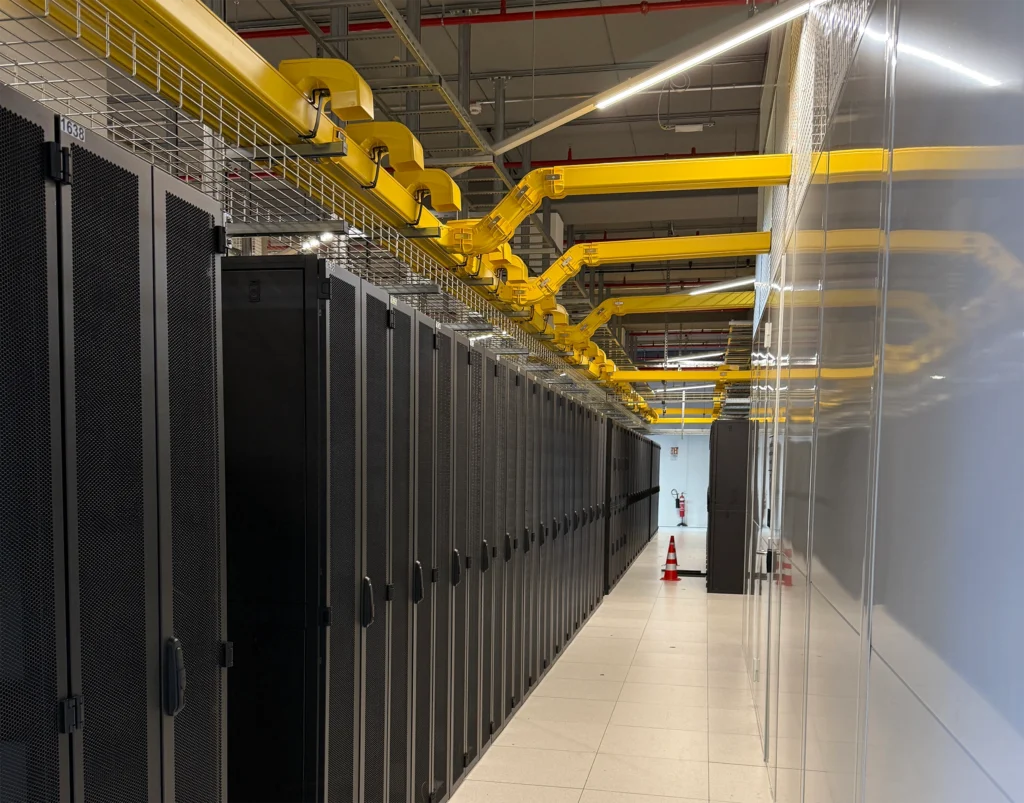
The term originates from English and translates to „ready to use.“ The image illustrates the principle: the client takes over a plant and metaphorically only needs to turn the key to start operations immediately.
What is a turnkey solution?
In this project model, a service provider assumes full, seamless responsibility for a project, including the initial concept, overall planning, and final commissioning. The result is a fully functional system ready for immediate use.
What are turn-key projects?
These are complex construction or infrastructure projects that are handed over turnkey as custom-made, one-off builds. All technical and administrative risks lie with the contractor, which completely relieves the client.
What services does a turnkey solution for data centers include?
The model brings together all the critical departments, such as the Architecture, These include the power supply, the air conditioning of the server rooms, fire protection, and extinguishing systems. Furthermore, the procedures for obtaining regulatory approvals and final load tests under real-world conditions are included.
When is a turnkey solution worthwhile?
The approach makes sense when companies do not want to maintain their own construction departments or want to relieve the burden on internal teams. This model ensures success, especially with highly complex projects during ongoing operations, as the service provider is liable for error-free interface coordination.
What happens after the handover?
The fully operational overall system officially transfers to the customer's ownership, followed by intensive training of the internal operating teams. Depending on the scope of the contract, regular maintenance and technical support by the service provider will follow.